Professor, Industrial Engineering and Operations Research (IEOR), Electrical Engineering and Computer Science (EECS), and School of Information (I-School), UC Berkeley
Home page
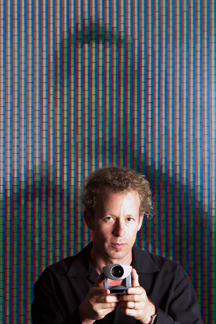 Ken Goldberg is an artist and professor of robotics at UC Berkeley. His work has been exhibited at the Whitney Biennial, Venice Biennale, Pompidou Center (Paris), Walker Art Center, Ars Electronica (Linz Austria), ZKM (Karlsruhe), ICC Biennale (Tokyo), Kwangju Biennale (Seoul), Artists Space, and The Kitchen (New York). He has held visiting positions at San Francisco ArtInstitute, MIT Media Lab, and Pasadena Art Center. Goldberg was awarded the National Science Foundation Young Investigator Award in 1994, the NSF Presidential Faculty Fellowship in 1995, and named IEEE Fellow in 2005. The Tribe, a short film he co-wrote, was selected for the Sundance and Tribeca Film Festivals. Ballet Mori, a multi-media project he developed to commemorate the 1906 Earthquake, was performed by the SF Ballet at the San Francisco Opera House.
Links: Home page | Artwork
Quote:
Technology aids suspension of disbelief but let’s not forget the resumption of disbelief.
