Assistant Professor of Communication, UC San Diego
Home page
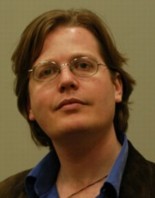 Noah Wardrip-Fruin, who will join the Communication Department at UC San Diego (appointment pending), is one of the leaders in the field of electronic literature and new media arts. After receiving his M.F.A. in Creative Writing from Brown in 2003 and while serving as one of Brown’s Traveling Scholars, he co-edited both The New Media Reader (MIT Press 2003) and First Person: New Media as Story, Performance, and Game (MIT Pres, 2004), which have been influential in establishing the field of new media studies. Wardrip-Fruin is a member of the Board of Directors of the Electronic Literature Organization. His many collaborative works of electronic literature include Gray Matters, The Impermanence Agent, the installation Talking Cure, and the Cave piece Screen. He is also a founding member of the well-known electronic literature and new media group-blog, Grand Text Auto. Currently, he is co-editing Computer Lib/Dream Machines (MIT Press, forthcoming).
Links: Home page | Grand Text Auto
Quote:
Under Construction.
